Monday, October 16, 2006

PUNISHMENT PARK: by Peter Watkins 1971


This movie could scarcely have been more timely. Punishment Park feels less like something that was made thirty years ago in our world, and more like something that leaked in sideways from an alternate universe gone horribly wrong. I doubt anyone in 1971 would have imagined that Punishment Park would still have relevance in 2006, but it does, and that fact alone is both exciting and ghastly.
In the late Sixties and early Seventies there was a small but thriving subgenre of movies that entertained alternate histories for the era. One of the most well-known (and most fun) was Wild in the Streets, which showed the Peace 'n Love generation coming to power and being just as thuggish and cretinous as the over-30 crowd they professed to hate. Another, all but lost to history, was Robert Kramer's little-seen Ice, a story of urban revolutionaries fighting back against repression in New York City (!). Punishment Park has similarities to Ice, but is far more immediate and engaging.
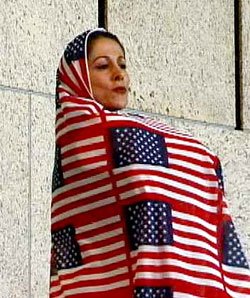
The movie posits a simple and horribly credible scenario: During the later years of the Vietnam War, hundreds of people are being arrested and kangaroo-courted in the United States for "inciting political unrest." They have two choices: lengthy prison sentences, or three days in Punishment Park, a stretch of California desert somewhere near Los Angeles. In Punishment Park, the prisoners are set free and forced to navigate a hostile stretch of burning terrain -- if they can reach the American flag at the end of the course within the allotted time, they are set free. Of course, they have more than the elements to contend with: Punishment Park is also used as a proving ground by police officers in training. If they get caught, they go to prison. "These officers have strict instructions not to molest you in any way," the controlling officer declares, and from the way he underscores those words verbally, we suspect there is going to be at least one blatant violation of that rule. We are right.


A new group of prisoners is given the option to go to Punishment Park.


I found it unlikely that any American director would have dared to film this material, and I was right: Punishment Park was created by British documentarian Peter Watkins. Watkins also directed the controversial and horrific War Game, a BBC-funded pseudo-documentary that wound up never being aired on the very network that funded it. Instead, it was released to theaters and later to TV and home video, and has become something of an underground classic in anti-war circles. It deserves a broader audience, especially in today's increasingly unsettled political climate.
The film cuts between two groups of people: one gang of prisoners who are just now being run through the farce of the tribunal, and another who are just now entering Punishment Park. The movie is not truly interested in any of them as individuals, but in a film like this, having individuals who stand out from the whole canvas would actually be a deficit. The point is not to create heroes and prop them up, but to depict a broad swath of possibilities. Every now and then, faces do swim out from the canvas: the balding, fat-necked tribunal master, or the angry black militant who speaks his piece of mind in court. The cops also get some camera time. "This was their choice," one of them says, referring to the Punishment Parkers. "They could have chosen to do a lot of things, but they chose instead to throw bombs and advocate the overthrow of the government. They're doing what they want to do, and I'm doing what I want to do."


The police are close behind as the runners slog their way through the desert.


One of the more interesting things Watkins does with the tribunal is populate it with a broad spectrum of the people that made up the "Silent Majority" in America. At one point we get a credit caption: Professor, Department of Sociology, University of Glendale. What's he doing here? The same thing as everyone else, evidently: getting his two cents in, and he does. There's another revealing moment where one of the runners (who bears a striking resemblance to Roger Daltrey) says, "They believe in protest and ritual defiance, and yet they participate fully in the rules for these games, and expect they'll come out the other end with the flag." When asked how things could be changed, he says, wisely, "I don't think anything can be done. I think we just got to evolve out of it." Sometimes even the tribunal members make sense, and I think that is exactly what Watkins wanted -- he's not here to side with either party, but to show the whole.
Watkins shoots the movie with a loose, fluidly improvisational camera style, and his editing juxtaposes sequences with biting intelligence. The parallels between this film and Battle Royale are obvious, although the two movies use markedly different approaches. Battle Royale was calculated melodrama -- searing social satire wrapped in the guise of an action movie. Punishment Park is very much an heir to Watkins' own War Game in its style and its detached, flat-affect feel. But Park and Battle Royale have something else in common, something subtle enough that it didn't come to me right away. In Battle Royale, the game was purposefully ludicrous: if it made sense, then the movie could be seen as investing it with credence it did not deserve. Punishment Park works the same way. The more we see of the park itself, the more we realize how it doesn't even work as a gladiatorial exercise -- it's a sham through and through.


The ultimate irony: they may not even be allowed to win.


Punishment Park was described as being "banned in the United States," but it is probably closer to the truth to say that it has simply never been shown here commercially. It premiered at Cannes to highly polarized opinions; the New York Times wrote (in a review that feels like Peter Sotos come 30 years early), "[it is] a movie of such blunt-wrong headed sincerity that you're likely to sit through the first 10 hysterical minutes of it before realizing that it is essentially the wish-fulfilling dream of a masochist. Because all literature, including futuristic nonsense like this, represents someone's wish-fufilling dream, I can't help but suspect that Wakins' cautionary fable is a wildly sincere desire to find his own ultimate punishment." The near-incoherence of this aside, I have to wonder why they were so eager to read in some hidden motive on Wakins' part for making it. Rolling Stone voted it one of the ten best films of 1971, while Playboy groused, "Seldom has the cause of peace and freedom been served so mindlessly" -- which assumed, incorrectly, that the movie was a knee-jerk vindication of the left.
Seeing Punishment Park released to video makes me wonder how many of Watkins' other, little-seen movies will come to the surface. Aside from The War Game, he has also made Privilege, an openly fictional movie about a future world church / government using pop music to control the masses -- another idea that today, like Punishment Park, seems to have undimmed relevance.

Wednesday, October 11, 2006

Wallowing Insane


The walk past the general store today was nice. I could smell the grass mixed with fertile soil after the rain. Virginia said she was going to leave me. After 12 years of marriage. I kept walking all the way to Dave's up the huge hill and past the parking German Shepard. I need a beer. The front of the bar is red brick. Built in the 1920's the bar used to be an old speakeasy. Bootleggers used to hide out in the basement that contains many tunnels.
The neon red sign to DAVE'S buzzes over my head as I walk in. Even at eleven in the morning the sign still acts as that beacon for the lonely. The solace for the disconnected and displaced.
I walk in and sit at the far end of the bar.
"Hi Walt" the bartender greets me.
"Hey" I wave to him.
Andy Stillmen is a large roly-poly of a guy, huge gut hangs like a shear cliff over his tight brown belt and a big dark brown beard wraps around his huge face. Combed over grey salt and pepper hair tries and camouflage a bald spot. He’s been a bartender here for 22 years. I look to Andy as my therapist. I talk he listens. He’s my Buddha. He gives me my redemption every time. I’m waiting for that one day when he looks at me and says. “Walt, your fucked”


I take my dark brown jacket off and hang it on a coat rack near a jukebox that plays Neil Young’s “New Mama”. I sit back down on the stool.

"So what will it be?” Andy asks.
"Just a beer...Pabst."
"Coming up."
He reaches under the bar and slides open a cooler pulling out a beer.
He pops the top and hands the cold beer to me.
"thanks"
I take a swig.
I look around the bar.
Almost empty except three other lonely, lost, horny, screwed up, junkie, poor people sittin at the bar.

As I look around the bar I catch my reflection in a mirror that lines the back wall of the bar.


It all stinks I think. She’s been out late the past week.
I’m not a hard man to live with.

She say’s she needs her freedom. That she’s doing stuff for us while she’s out. Making deals for me. Shmoozing.

What can she be doing?
My last book didn’t sell very well.
I’ve done five talk shows and some stupid ass fuckin filmmaker wants to do some kind of documentary about me.
How boring.
Looking at my mug for what an hour? Two hours?
I mean what can I say? I’ll feel like some kind of trained monkey.

“Another drink Walt?” Andy chimes in. His breath bouncing off my nose.
My god brush your teeth. I think to myself. I don’t want to embarrass the guy.
“Sure” I say.
“Whisky” I point to the good shit against the far wall.

I catch my reflection again.
I’m old.
I’m really fuckin old.
55 years old.
My skin sags around my neck. My hair is just about all fallen out.
My nose looks huge with all this saggin flesh.
My god what does Emily see in me. Good. I’m glad she’s gone.

She says I ignore her. She says I take her for granted.
I told her she’s getting things confused.
It’s the other way around. She takes me for granted.
I told her to get a good lawyer.

So she left.
And now I’m here. Lookin at myself in the fuckin mirror.

Suddenly a clean cut young man around 35 comes in and sits next to me. I can tell he recognized me and wants to say something.

Finally he gets the balls to say something. “Hi I really like your work, very honest writing.”

“Great” I say back. “Good” I scratch my left arm pit.

I take a drink. The whiskey going down smooth and warm. I can feel the warmth all through my body.

“I particularly like the book that you wrote about living in Los Angeles.”

“You do, do you?” I answer back. I’m annoyed. I want to be left alone during my crisis. I want to wallow.

“Why the fuck do you like that book?” He looked surprised that I responded back the way I did. He started fumbling with his words.

“Well I just like how you talked about everything…I mean I used to live in LA and…well it seemed very real.”

I fart really loud. A fart that shakes the bar. I think even the folks sitting across on the other side of the place heard me. Fuck. The people upstairs heard it. The dishwasher heard it and dropped and broke several mugs onto the ground. Women were running out of the joint.

I just smiled.

The poor kid got up and left without even saying good-bye.

Hummm…was it something I said?


To be continued

Tuesday, October 10, 2006

Roger and Me By SCOTT FOUNDAS


Scott Foundas responds to Ebert’s critic-bait
By SCOTT FOUNDAS
Wednesday, January 18, 2006 - 8:30 pm
Dear Roger:

Save for the storied contretemps between Pauline Kael and Andrew Sarris, film critics are generally far too busy reviewing the new movies that open each week to spend much time reviewing each other. So I was understandably surprised to read your January 8 Chicago Sun-Times editorial “In Defense of the ‘Worst Movie of the Year,’” in which you lambasted my opinion of Crash, a movie you have repeatedly praised as being the best of 2005. Specifically, you were referring to comments I made in the recent Movie Club forum at Slate.com — a discussion about the past year in film that also included contributions by critics A.O. Scott of The New York Times, Jonathan Rosenbaum of the Chicago Reader and Slate’s own David Edelstein. As your headline suggests, I wrote in the forum that Crash was among my least favorite movies of 2005 and called it “one of those self-congratulatory liberal jerk-off movies that roll around every once in a while to remind us of how white people suffer too, how nobody is without his prejudices, and how, when the going gets tough, even the white-supremacist cop who gets his kicks from sexually harassing innocent black motorists is capable of rising to the occasion.”

I stand by those words and, as you point out, I am not alone in such sentiments. Your essay quotes negative Crash reviews by MSNBC critic Dave White and even the editor of your own Web site, Jim Emerson. To which I would add that, upon its release back in May, Crash received mixed-to-negative reviews from Edelstein in Slate and Scott in The New York Times, as well as from many other critics writing in the Los Angeles Times, Newsweek and The New Republic, among other publications. In the 2005 Village Voice poll of more than 100 major North American critics, Crash was cited by only four participants as one of the year’s ten best films, for an overall 66th-place showing in the survey. And lest anyone surmise that this amounts to some sort of contrarian backlash against a widely praised film, I should note that way back during the 2004 Toronto Film Festival, three-quarters of a year before Crash arrived in commercial cinemas, Variety critic Todd McCarthy wrote that the movie offers “a narrow, ungenerous and, finally, unrepresentative view of the world, one that suggests people are correct in suspecting others as having only the worst motives.”

I couldn’t have put it better myself, but maybe you, Roger, could have. In describing Crash, you’ve written: “A white racist cop sexually assaults a black woman, then the next day saves her life. His white partner, a rookie, is appalled by his behavior, but nevertheless later kills an innocent man because he leaps to a conclusion based on race. A black man is so indifferent to his girlfriend’s Latino heritage that he can’t be bothered to remember where she’s from. After a carjacking, a liberal politician’s wife insists all their locks be changed — and then wants them changed again, because she thinks the Mexican-American locksmith will send his “homies” over with the pass key. The same locksmith has trouble with an Iranian store owner who thinks the Mexican-American is black. But it drives the Iranian crazy that everyone thinks he is Arab, when they should know that Iranians are Persian. Buying a gun to protect himself, he gets into a shouting match with a gun dealer who has a lot of prejudices about, yes, Arabs.” That, in a nutshell, is as succinct a summary as I’ve read of everything that’s wrong with this picture. If only you’d managed to mention that the two carjackers who, when they’re not perpetrating grand theft auto, engage in animated debates about black-on-black racism and hip-hop as “music of the oppressor” — scenes aptly described by the name of one of the actors featured in them: Ludacris. (To answer your rhetorical question, Roger: If I were carjacked at gunpoint by these two guys, I wouldn’t “rise to the occasion with measured detachment and sardonic wit.” I’d merely wait for Ashton Kutcher to appear and tell me I’d been punk’d.)

I’ve said that Crash, which was co-written and directed by Paul Haggis, doesn’t accurately reflect the city of Los Angeles as I’ve come to know it after more than a decade of living here (during which time I’ve made lots of meaningful connections with others, none of which have been the result of a car accident). But as I think back on the film, I’m not even sure that it reflects life as we know it on planet Earth. The characters in Crash don’t feel like three-dimensional, flesh-and-blood human beings so much as calculated “types” plugged by Haggis into a schematic thesis about how we are all, in the course of any given day, the perpetrators and the victims of some racial prejudice. (Nobody in Haggis’ universe is allowed to be merely one or the other.) They have no inner lives. They fail to exist independently of whatever stereotype they’re on hand to embody and/or debunk. Erudite carjackers? A man who can’t remember his own girlfriend’s ethnicity? You may see such things as “parables,” but I call it sloppy, sanctimonious screenwriting of the kind that, as one colleague recently suggested, should be studied in film classes as a prime example of what not to do.

But then, Roger, perhaps all of us detractors are simply, as you put it, “too cool for the room.” According to you, we critics must bear in mind “the ways in which real people see real films,” the same people who you say enjoy paying to be manipulated. (And who’s to argue, when the officials currently holding our nation’s highest elected offices offer living proof that many of us enjoy being manipulated for free?) You go on to say that you’ve talked to dozens of viewers who were touched by Crash, and while I don’t deny that, I have had my own conversations about Crash with plenty of “real people” who feel less touched by the film than manhandled by it. Among e-mails I’ve received from Slate readers, one goes so far as to speculate that people are afraid to admit they don’t like Crash for fear of being considered racists themselves — and I think the film is engineered to make viewers feel that way — while another, somewhat more charitable correspondent quotes Oscar Wilde’s maxim that “all bad art is sincere.”

Finally, you express surprise that anyone could feel contempt toward a movie like Crash in the same year that witnessed the release of Chaos and Deuce Bigalow, European Gigolo. But as I stated in Slate, by calling Crash the worst movie of the year, I don’t mean to suggest that it’s entirely incompetent or even a catastrophic all-star debacle on the order of The Bonfire of the Vanities or Town & Country. No, Crash asks (and expects) to be taken much too seriously for that kind of rote dismissal. So, why contrast Crash against two unrepentant, bottom-of-the-barrel stinkers — one a no-budget horror movie that took pride in using bad reviews as part of its promotional campaign and the other a lowbrow Rob Schneider comedy — rather than placing it in the context of those other movies from 2005 that so much more subtly and intelligently (and no less sincerely) grappled with the effects of race and class on our daily lives? I’m thinking, of course, of Michael Haneke’s brilliant Caché — my own pick for the best film of last year — and also about George Romero’s Land of the Dead, both of which are studies in how (mostly white) people of privilege attempt to seal themselves off from society’s “undesirable” elements (who just so happen to be people of color). And while we’re on the subject, I might as well mention Lars von Trier’s soon-to-be-released Manderlay, which premiered at festivals in 2005, and is about the very kind of psychological enslavement that might lead a group called the African-American Film Critics Association to present Crash with a best-picture award.

Haggis is right about one thing: None of us is without prejudice. You’re right that in my notes on Crash, I neglect to mention the name of the actor who plays the Mexican-American locksmith; in your editorial, you say with the utmost certainty that “when two white cops stop you for the wrong reason and one starts feeling up your wife, it is prudent to reflect that both of the cops are armed and, if you resist, in court you will hear that you pulled a gun, were carrying cocaine, threatened them, and are lying about the sexual assault.” These are indeed troubled waters, but if Crash is what qualifies as “a bridge towards tolerance,” excuse me while I phone my auto-insurance agent and increase my premium.

Sincerely, Scott Foundas

Friday, September 29, 2006

Sunday, September 24, 2006

Faith by Antony Berrios


FADE IN:

INT. APARTMENT/HALLWAY DOOR - MORNING

The face of DARIUSH, a young Iranian boy of ten with brown
short hair, fair skin and big brown eyes stare at us through
a 1/2 open door.

The muted sound of Iranian music plays from somewhere
within the apartment.

Obscured a bit by the door frame Dariush watches his father
ALI, late forties, dark beard and brown eyes. As he moves
back and forth from dresser to his suitcase as he packs his
belongings. His clothes are casual, black slacks and a dark
blue polo shirt. His mother DORRI, forties, brown hair
pinned up. A few strands hang in her face. She holds a
tissue up to her face. She sits on the bed next to the
suitcase. She looks as though she has been crying.

Assorted family pictures are on display on the top of the
dark oak dresser. Clothes are strewn about upon the bed.
Ali picks up one of the pictures that rest on the dresser
and puts it in the suitcase. Ali sits on the bed next to
Dorri. Ali touches her hand then kisses her cheek he moves
back the few stands of hair that were in her face.

Dariush accidentally scrapes the door.

Dorri looks up to the door.

Dariush's eyes begin to well up as he watches his father
and mother.

DORRI
Whose there?

Suddenly Dariush turns and runs away from the door.

Ali walks to the door and opens it. He catches a glimpse
of Dariush running down the hallway.

INT. ALI'S APARTMENT - CONTINUOUS

Dariush runs down the hallway past the kitchen.

Dariush flings open the front door and runs out of the
apartment slamming the door shut behind him.

EXT. ALI'S APARTMENT - CONTINUOUS

Dariush almost runs into Fariba (40's) and Shaheen (40's)
who are walking up to the front door of his family's
apartment.

FARIBA
Dariush!

----------------------------------------------------------------------------------------------------
2.


Dariush screams past ELIZABETH a woman who lives in the
apartment building who has her arms full of shopping bags.
She moves off the sidewalk onto the grass to avoid crashing
into Dariush and drops a few packages to the ground.

FARIBA (CONT'D)
What is he doing?

Dariush disappears into the distance.

INT. FRONT DOOR -- CONTINUOUS

Dorri wearing a green apron that reads "Kiss the Cook" now
stands at the front door with her sister Fariba and her
husband Shaheen.

FARIBA is a short woman in her mid forties. Her hair is
pulled back tight into a small bun onto the top of her head.
SHAHEEN her husband is slightly balding and has a thick
mustache. He appears to be in his late forties.

Dorri holds three year old LILLY in her arms. Lilly has a
small little yellow matching outfit on. Yellow small shorts
yellow shirt. The shirt reads "Kiss me Too"

FARIBA greets Dorri, kisses both her cheeks. Dorri grabs a
small bag of groceries from Fariba with her right hand while
still carrying Lilly in her left.

DORRI
Here, let me help.

SHAHEEN
Hello.

Shaheen moves in and kisses Dorri and both cheeks.

FARIBA
Get Ali to help you with the other
things in the car. Dariush past us
as he ran out.

Dorri shakes her head.

DORRI
Let's bring all this into the
kitchen.

INT. KITCHEN - AFTERNOON

They put all the groceries down. Fariba starts to take
things out of the bags.

Dorri walks over to the hallway and yells for Ali.

DORRI
Ali! Ali! Come help.

----------------------------------------------------------------------------------------------------
3.


Dorri walks back into the kitchen. Shaheen walks out the
front door to the car.

EXT. APT. COMPLEX - AFTERNOON

Shaheen walks up to the trunk of his dark blue CRV. He
opens up the trunk. He pauses and lights up a cigarette as
some children run by him chasing each other and laughing.

Ali walks out of the front door toward him. Shaheen walks
up to him. They shake hands and kiss on both cheeks.

ALI
Hi.

Shaheen starts to grab some groceries, his cigarette in his
mouth dangling. Ali moves around to the other side of the
car to take some bags when Shaheen hands an envelope to Ali.

ALI (CONT'D)
What's this?

SHAHEEN
For you.

Ali puts the bags back down and opens up the envelope.
Inside the envelope Ali finds a thick stack of US $100.00
bills. He thumbs through the hundred dollar bills. Then
closes the envelope back up and hands it back to Shaheen.

ALI
Thank you very much, but I can't
accept this.

SHAHEEN
Please.

ALI
No I can't.

SHAHEEN
You must.

ALI
You embarrass me. I can't take
your money. Please. I don't know
what to do?

SHAHEEN
This is all a big mistake you'll
see. You'll be back before you know
it.

ALI
Mistake.

Ali shakes his head.

----------------------------------------------------------------------------------------------------
4.


Shaheen reaches into his jacket and hands Ali a piece of
paper.

SHAHEEN
Take my sister's address.

Ali puts the paper with the address into his back pocket.
They grab the rest of the bags. Shaheen closes the back of
the car and they both head toward the front door.

EXT. A LARGE FIELD - DAY

Dariush runs in a large field. We follow beside him as he
jumps over tree limbs and weaves around bushes. He runs
faster and faster not slowing down. Then suddenly he trips.
He takes a nasty fall onto the ground. He picks himself up.
His palms are slightly bleeding. His chin is scraped up.
He walks over to a tree and sits under it.

A stray cat wanders near him. The cat looks beat up and
old. It pants hard.

DARIUSH
Hello. Come here.

The cat moves slowly, crawling on the ground. Dariush
moves over to it. As Dariush takes a closer look at the
cat, he can see that the cat looks as though it has been
injured. The car looks up to Dariush. Their eyes meet. He
lightly pets the cat's forehead. Dariush moves down to eye
level with the cat leaning his head to the ground using his
arm as a pillow. He watches the cat as it tries to breathe.

DISSOLVE TO:

INT. APARTMENT/DARIUSH'S BEDROOM - MORNING

Dariush sleeps soundly in his bed. The early morning sun
pushes into the room from some half open blinds over
Dariush's bed.

Ali slowly walks into Dariush's room he sits down on the
corner of his bed. He looks down to his son who is sound
asleep entwined with sheets. Dariush awakens, rubs his eyes
a bit then looks up to his father.

Dariush sits up straight in bed startled.

ALI
Get dressed and join me in the
workroom.

Ali gets up and walks out of the room.

Dariush looks as if he has done something wrong. He pulls
back the covers on his bed, he wears Captain America Pj's.
He slowly walks out of his bedroom.

----------------------------------------------------------------------------------------------------
5.


INT. HALLWAY -- CONTINUOUS

Dariush walks into the bathroom shutting the door behind
him.

INT. ALI'S BEDROOM -- MORNING

Dariush slowly enters Dorri and Ali's bedroom, the sound of
someone sanding can be heard. The sound getting louder and
louder as he nears a halfway open door.

INT. WORKROOM - MORNING

The room which once was a walk in closet as been remolded
to act as Ali's workroom. We have stepped back into Iran.
A huge mural covers the far wall. The mural is of an open
window. The window looks out over lush field where large
tree stands next to a small house.

Family pictures are tacked to the wall in front of his work
bench. Next to the mural is a black and white picture of
the same image on the wall. The workbench is small and
rests lengthwise against the wall of the closet. Other
tools hang on hooks on the wall in front of the bench. A
dozen raw WOODEN TOPS are all perched on a shelf over the
work bench.

Dariush peeks his head into the workroom. Ali turns and
catches his son peeking in.

ALI
Sandpaper.

DARIUSH
Huh?

Ali points to a small bin of sandpaper under the workbench.

ALI
There.

Dariush walks into the room and grabs some sandpaper under
the work bench. Ali snaps his fingers.

ALI (CONT'D)
Wake up. Sand those. Come on!

Dariush picks up one of the tops and starts to sand it. He
watches his father who is sanding. Dariush starts to mimic
his father. Flakes of color from the sanding rain down like
snow onto their feet.

They both work in silence except for the sound of sanding.
Ali watches his son from the corner of his eye.

ALI (CONT'D)
Good. Good.

----------------------------------------------------------------------------------------------------
6.


Ali observes his son. Dariush has moved closer to his
father. Ali puts his cigarette down and looks as though
he's about to tell Dariush something but hesitates. Dariush
coughs from his father's smoke. He tries to hold his breath
but can't.

Ali grabs the top from his son showing him how to do it.

ALI (CONT'D)
Be strong with it. Don't do this.

He mimics what his son was doing. Dariush watches his
father. Ali hands the top back to his son.

Dariush puts more pressure on the top this time. His
father reaches on a shelf above his head and grabs a top.
He avoids his son's gaze as he sets the top down on the
table next to Dariush.

Ali touches his son's head while nodding to him that he's
doing it right. Dariush stops for a moment and picks up the
top his father set on the table. Ali's sanding becomes fast
and furious.

Dariush touches the top. He runs his fingers over all the
crease and imperfections. The top is painted with bright
gold and reds with a blue line going all round the top. As
Dariush turns the top around he notices that his name is
carved into it. Dariush looks up to his father smiling.
Ali puts down his tools and puts is arm around his son
hugging him tight.

Dariush takes the top and spins it.

CLOSE UP:

The top spins furiously until it begins to wobble and
eventually falls over.

EXT. OPEN FIELD - EVENING

Dariush sits alone under a tree. He brushes himself off
and walks down a dirt embankment towards his apartment
building.

INT. KITCHEN - EVENING

Dorri and Fariba are cooking dinner together. Lilly helps
Fariba with cleaning the vegetables in a in the kitchen
sink. Shaheen walks in from down the hall.

FARIBA
Oh there you are. Here are some
plates.

Shaheen takes the plates. They exchange a look. Dariush
comes into the house.

Dorri sees him walk in.

----------------------------------------------------------------------------------------------------
7.


DORRI
There you are. Help us set the
table.

DARIUSH
Gotta wash up first.

He shows his mother his hands, dirty and a bit bloody.

DORRI
What did you do?

DARIUSH
I fell.

DORRI
Go wash up.

INT. LIVING ROOM - EVENING

Place settings are set out for everyone. Serving bowels are
on the table brimming with hot food. Lamb, beef, eggplant,
fried spinach with yogurt, tomatoes, cauliflower. The food
itself is colorful.

Ali walks in and sits at the head of the table.

Dariush sits next to him. Dorri sits on the other side of
Ali. Lilly sits next to her mother and across from Dariush.
Shaheen and Fariba join the family at the table.

Dorri and Fariba start serving the food. Good portions for
everyone.

A large window frames the table facing out toward the front
of the complex. White sheer curtains diffuse the descending
sun. They each start eating in silence.

Dariush looks up to his father.

Ali taps on a glass getting everyone's attention.

ALI
I want to thank you. Thank you
Fariba and Shaheen for being her
tonight. Let's not dwell on the bad
but focus on the good. Thank you
Dorri and Fariba for this wonderful
food.

Ali toasts and they all take a drink.

Food passes back and fourth.

Through the white sheer curtains of the dinning room window
the silhouette of a van on the street parking outside the
apartment building can be faintly made out. The family
continues to eat.

----------------------------------------------------------------------------------------------------
8.


Two silhouetted figures walk from the van up the walkway to
the front door.

Suddenly there is a knock on the door.

The family all stops eating and talking. Ali looks over to
Dorri.

As Ali turns his head, Dariush sneaks a taste of his
father's wine.

Dariush watches as Ali stands up from the table. Dorri
stands with him picking up Lilly into her arms. They both
go to the door and open it.

Fariba and Shaheen stand up as well and walk over to the
door.

From a distance and a bit obstructed by the corner of a
wall Dariush observes his father opening the front door.
His father invites two men into the apartment.

Dariush sees the two men.

One man appears to be Persian the other looks to be Asian.
They both wear dark blue wind breakers with the letters INS
in yellow on the back and smaller on the front next to each
man's name: Andy Yen and Hamid Golbahari.

ANDY YEN
Ali Shiraz?

Dariush watches Ali nod. Dariush goes back and forth from
looking at his dinner plate and observing his reflection in
the plate and back up to his father.

HAMID GOLBAHARI
I'm sorry. We have to go.

Dariush looks back up and watches his father pick up his
bags that sit next to the front door waiting. Ali turns and
looks over to his Dariush. Dariush immediately looks back
down to his reflection.

Dorri starts to fix Ali's shirt collar.

DORRI
I'm trying not to cry. It's hard.

Dariush looks back up and sees his mother moving in and
hugging his father while holding Lilly. Dorri starts to
cry.

Fariba and Shaheen move over to console Dorri.

Dariush looks back down to his plate holding back his tears
as he hears his father speaking to his mother.

----------------------------------------------------------------------------------------------------
9.


ALI
(collecting himself)
No tears. It will be okay.

Dariush looks back up at Fariba as she tries to move Dorri
off of Ali.

Dorri jerks and pulls away.

DORRI
No! Please!

FARIBA
Dorri.

ALI
It's going to be okay. You'll see.

FARIBA
Come on.

Dorri and Fariba embrace. Lilly starts to cry in Dorri's
arms.

Dariush looks out the big window at the van parked on the
street. He then turns back and meets his father's eyes.

Ali puts his bags down and walks over to his son who keeps
looking back to his plate. Ali bends down to his son's
level. Dariush looks at him and stares for a moment. He
reaches out and hugs his father tight. He starts to cry.

ALI
Take care of your mother and sister.

Dariush shakes his head "yes" while hugging his father.

Ali walks over to Lilly who holds her mother's hand. Ali
bends down and kisses her forehead.

Ali grabs his bags as the INS agents escort him out of the
apartment.

Dariush stands up from the table and walks over the window.
As Dariush pulls back the curtains he watches his father
being taken to the van. The van door slides open. They put
his suitcase and duffel in after him. He pauses for a
moment before and looks back at Dariush. Ali ducks down and
enters the van.

INT. VAN - CONTINUOUS

The van door is pulled shut. Ali watches Dariush through a
small tinted van window.

Ali's hands are pulled back and handcuffed.

FADE TO BLACK.

A Conversation between Jonas Mekas and Stan Brakhage


The following conversation took place at Anthology Film Archives, in New York, on November 3rd 2000. It was originally recorded for Vogue Magazine, only a small portion of the conversation was actually published in the magazine. We present here a more substantive extract from a conversation between two of the most eminent figures in avant garde cinema.


Jonas Mekas: Here you are, Stan Brakhage, whom not only for me, but for most of those who write serious film criticism, or make movies, considered as possibly the number-one living filmmaker, both in the importance of the body of your work and in your influence on other filmmakers.

Stan Brakhage: And here is what you are to me: in addition to being a great filmmaker who has forged ahead in an area where you are practically unique, that is, the diary, journal film, you are the only one who has created a believable, meaningful, extended journal across most of your adult life. In addition to this, you have found a way to sponsor films that you love and to create cooperatives through which they can be distributed; to create Anthology Film Archives so that they could be preserved and shown in a repertoire and continue today to be certainly the only place for what we want to call Poetic Film. So, you have not only done these two things, but you also have this rich life as a poet. Not knowing Lithuanian, I can just read the English translations of your work, which are very moving to me. I don’t know how you keep all this going.

JM: We both have been in it all for fifty years now. You have been making films since 1953. And me, in the Spring of 1953 I moved to the Lower East Side of New York and opened my first showcase for the avant garde films at the Gallery East. I showed Kenneth Anger, Gregory Markopoulos, Maya Deren, and Sidney Peterson. So you see, I didn’t move very far.

SB: Well, the man who really gets something done is the one who can stay at home. Of course, ironically, you are an exile, exiled from your home [Jonas Mekas was born in Lithuania and emigrated to the United States shortly after World War Two].

JM: We lived in a century where for maybe half the world it was made impossible to remain at home. So now, I often say that cinema is my home. I used to say culture was my home. But it got a little bit confused. Nobody knows what culture is anymore. So I stick to cinema.

SB: That’s where you and I first got into trouble, with what culture was, and art. I was so frightened the social concerns of the sixties would overwhelm the long-range aesthetic possibilities, as I viewed them. As I look back on it now, I think that you were largely right, that I needn’t have been afraid for the arts in the ways in which I was. Let’s say, many of the films that came out were very stupid from a standpoint of art, or aesthetics or even craftsmanship. Still, they were crucial to the moment.

JM: When we celebrated Anthology Film Archives 30th anniversary, I got together with Ken Kelman and P. Adams Sitney and we talked about the creation of the Essential Cinema Repertory, which consisted of some 330 titles of very carefully selected films that we felt indicated the perimeters of the art of cinema. We came to the conclusion that we did not make any bad mistakes in our choices. I discovered that what I showed, what I promoted, all ended up in the Essential Cinema Repertory, the films that are now considered the classics of the sixties. There were, of course, some that did not become classics. Important works are always surrounded by some that are not that important, but as time goes they fall off. In a sense, it’s like Darwin’s law applied to the arts. Not the biggest, but the most essential survive.

SB: I was afraid the lesser works would sink the ship.

JM: They just evaporate. Your work, or that of Kenneth Anger, Maya Deren, and Michael Snow, they just keep growing.

SB: But I also wonder if that doesn’t have more to do with what you provided.

JM: What came up during my conversation with P. Adams Sitney, was that what’s lacking today is serious or passionate writing on the contemporary avant garde film. That, of course, was my function in the Village Voice, via my column Movie Journal.

SB: I don’t know any. Is there any aesthetician or critic or any kind that regularly deals with the Poetic Cinema in the entire North American continent?

JM: There are many alternative newspapers and monthlies, but none of them cover the Poetic Cinema, They are all writing about Hollywood-kind of the film.

SB: That’s also pretty much true now for poetry, architecture, or some of the performance arts: there is no regularity of coverage.

JM: You walk into a newspaper store and you see twenty, thirty magazines on art, but inside you see nothing but advertisements.

SB: In defense of myself, one of the ways I got most laughed at, in the sixties and seventies, was when I tried to defend the word art. I finally had to give it up because it was taken away by everybody and applied to every kind of consideration. It ceased to be a meaningful word.

JM: I read a survey conducted by Peter Moore, who had a column in Popular Photography magazine in the mid-60s, where people were asked whether they felt they were artists. Six million people said they felt they were artists. Of course, when you have six million artists in one country, then you give up using the word art.

SB: Pretty soon, someone said, half the American nation will be teaching art to the other half.

JM: Some terms get so overused that you have to forget about them for a while until time cleans them up.

SB: We have other words that have suffered from this, words like “love,” “God,” “evil.” So I would say that it isn’t just film that suffered from these difficulties. All the arts, what we traditionally call the arts, have suffered from this breakdown of terminology, this lack of serious critique. Here is a discipline far older than any other we know of human beings, but when it’s taught in public schools, in fact in colleges, it’s taught as a playground for finger painting and for expressing yourself.

JM: I would like to bring something else up. When you began making films in the early fifties, and when I turned to cinema, around the same time, there were several other very important developments in the arts – action painting, the improvisational theater of Strasberg, the Happenings theatre, conceptual art, Fluxus, and video art – and it all somehow produced a thing called installation art, which has developed and grown. Now that installation art has swallowed video, film, sculpture, painting, and everything else, I meet more and more young people who are interested in returning to the very basis of their arts. At some point you have to go back to the very essence: what is really music, painting, cinema, poetry, etc.

SB: Remember, when we were choosing the name Anthology Film Archives, we thought that there should not be the article “the”, because we thought there will be other anthologies and that they would contradict our Essential Cinema list and that would set up a dialogue.

JM: No, that did not happen. We were the only ones who were crazy. Same as when Andy Warhol was making his film portraits. I thought and I wrote in the Village Voice, that the time will come when everybody will be making film portraits, because it’s so easy. Nobody imitated Andy. They cannot imitate Warhol, or Dreyer, or you. All those things happen only once, and that’s the beauty of it

SB: That’s also the great truth. I have come to an age when I mostly say “I don’t know.” That’s what passes for wisdom. Some few things I do know. One thing I know is that there’s no two people on Earth alike; all their cells are as unique as snowflakes.

JM: But the interesting thing is, that despite the fact that every snowflake has its own shape, beyond the shape there is water. Somewhere they all meet, somewhere we all meet. When people call me an independent, I usually say, no, I depend on many things, my friends, my past, what I read, all the poets.

SB: Gertrude Stein said there are those who are independent dependents, and those who dependent independents.

JM: Now I want to talk to you, dear readers. Nobody else will ever do what Stan Brakhage, or Ken Jacobs, or Kenneth Anger are doing. So we better love them, help them, and take care of them. These are such unique achievements of the human spirit, like fragments of paradise on earth.

SB: This is really that side of you that could not stand to see what you cared for and loved and respected just scuffled aside; that you deeply felt you needed to speak for them and save and preserve them.

JM: I think it’s a very unfortunate mistake to think that what the avant garde filmmakers are doing is something very far out and not for the everyday. People seem to think that our lives, or the strangeness of our lives may be of some interest, but not our work. But I think the work is universal, because poetry is universal. There is no difference between reading a volume of Sylvia Plath and seeing a film by Stan Brakhage. I wonder where ideas that Poetic Cinema is more difficult to appreciate come from. In schools Faulkner and Olson are taught in the same classes. In literature the kind of separation that is made in cinema does not exist.

SB: There is a kind of professor that knows that is he or she books Hollywood movies only, that they will be popular. They will have huge classes and secure their tenure… Whatever it is, I still continue. I am mostly painting on film now and it takes time to make twenty-four individual frames for every second, but that is really all I can afford. I can afford only a few photographed films.

JM: My own diaristic style came very much from that fact that I had no time and money to make a scripted, “conventional” film. So instead of making films I just filmed. I sometimes joke, I say I am not really a filmmaker; I am only a filmer. I film real life. I never know what will come next. The shape of my films emerges from the accumulation of the material itself. I go through my life with my Bolex camera. Here is a question for you. Let’s take a film you did in Canada, The God of Day Looked Down Upon Him. Did you see its shape in your mind when you began it, or did that shape developed as you went along?

SB: I knew from the beginning it was the third part of a trilogy. The title comes from Charles Dickens’ David Copperfield. This was the first summer we went back to this place on Vancouver Island where my wife was raised. I still was hairless because of the chemotherapy; I had come very close to death. So I was in the mood to see that ocean in relationship to the end, or to the night, or to the darkness. My head was filled with things like Rothko’s old age paintings, like the Houston Chapel. That Chapel saved my sanity. Also Braque, the old age Braque, the real brown period, with the wooden plow. I felt old like that, I had expected to die, and I still expect to die any moment.


JM: I just wanted to know for myself, if you had any idea, feeling of the shape before you began filming it. To make a film, a filmmaker is one who already at the beginning sees its shape more or less. But I never have that. I am just a filmer, because it’s life. I don’t know what the next moment will bring, and when I will want to film.

SB: But you’re such a stylist. You know that it all hangs together. I called you the Samuel Pepys of film because you’re a stylist in that sense.

JM: Yes, but the style and the techniques come from the content, from this procedure. I am dealing with real life from moment to moment and instantaneously.

SB: Do you ever think about money?

JM: I never think about money.

SB: I knew you’d say that.

JM: There is a space next to Anthology Film Archives where we are going to build a library for the largest collection of written material on avant-garde/independent cinema. It will cost $3.5 million. I know the library will be built. All it takes is to believe in it, and work, work, work…

Logos 2.2 - spring 2003
© Logosonline 2005

Friday, September 22, 2006

Goodbye If You Call That Gone: BY GROVER LEWIS


History and legend bind us to the past, along with unquenchable memory.

In the spring of 1943, my parents—Grover Lewis, a truck driver, and Opal Bailey Lewis, a hotel waitress—shot each other to death with a pawnshop pistol. For most of a year, Big Grover had stalked my mother, my four-year-old sister, and me across backwater Texas, resisting Opal’s decision to divorce him. When she finally did, and when he finally cornered her and pulled the trigger as he’d promised to do, she seized the gun and killed him, too.

A next-door neighbor of Opal’s—called “Dad” North because of his advanced age—witnessed the mayhem shortly after dawn on a rainy Monday morning in May. Big Grover was twenty-seven years old, Opal twenty-six, and they’d been married for almost eleven years. My father survived for half a day without regaining consciousness, and died in the same charity hospital where I was born. Opal died where she fell, under a shadeless light bulb in the drafty old rooming house where she’d been living alone and struggling to keep Titter and me in a nearby nursery school. No charges were filed, and a formal inquest was considered unnecessary since the police and the coroner’s office declared the case solved by mid-morning. My uncle Dubya Cee, Opal’s older brother, talked to one of the detectives involved and found out some additional information, which he shared only with the Bailey elders. Such, anyway, were the bare bones of the story as passed along in family history that soon blurred off into murky family legend. It was the sum of what I was allowed to know, although there remained to be answered, of course, questions I had not yet learned to ask.

Grover and Opal were strong, attractive, hardworking people with no history of wrongdoing. They’d started out as Depression kids who’d eloped from the working-class district of Oak Cliff in Dallas, where they’d both been youthful friends of the notorious Southwestern desperadoes Bonnie Parker and Clyde Barrow, who’d died in a police fusillade six months before I was born. Like Clyde, my father was an unschooled country jake who fell—or jumped—into low ways in the big city. Big Grover and his two older, rakehell brothers, Lester and Cecil—“Leck” and “Cece”—had been coughed up by the dust storms of the 1930s and were among the first generation of Texas boys to grow up without the idea of the American West beckoning them to fortunes untold. By their time, America was “all took up.” Opal, like Bonnie, was a bright student who’d left school early to help support her family before meeting and running away with her first true sweetheart—a moral girl, everybody agreed, with high ideals. Like Bonnie’s, Opal’s main crime seems to have been picking the wrong man to love. In the end, she managed to save my father from everybody but himself.

The fatal events took place in my hometown of San Antonio when I was eight. By then, I had experienced at first hand such a numbing amount and so many varieties of violence that I was left with the choice between an invitation to death and the will to live. My sister, still only a toddler, was almost oblivious to the calamity and would forget our parents completely within a year or so, but complex guilt and mourning and survivor’s self-loathing gnawed at me without letup. In my foreshortened child’s perspective, I worried about my own culpability in the bloody strife that had descended on us, overcome with remorse that I might have been more watchful, that I ought to have tried even harder to protect Opal and stave off our fate. In the secret, nonverbal chamber of the heart where unquenchable memory takes root in childhood, I knew many things on a dim level—but I knew them well enough. In our year on the run and its desperate aftermath, I had stored up memories I couldn’t get rid of and memories I wouldn’t let go, including the awful knowledge that Opal had been betrayed by one of our own family circle—that news of our whereabouts had repeatedly been passed along in secret to Big Grover in his darkening rage by a man who had often sat at our table in happier times and pretended to love us all. In an icy flash, I understood the horrifying extent to which life is shaped by chance and happenstance, and how abruptly the unexpected can strike and obliterate everything you most cherish. Chaos, I sensed, lay hidden beneath the superficial order of the normal, where the solid rules of right and wrong were displaced by treachery, corrosive passion, and sudden death. I was, you must understand, just at the threshold of the age of reason, trying to sort out for the first time without Opal’s help the possibly true from the wildly improbable.

With Big Grover commonly understood to be the wrongdoer and the case closed, the bereaved families assembled to pay their respects, some missing a day or two’s work and driving in from such distant points as Dallas, the Red River Valley, and rural Oklahoma. The mourners made over Titter and me with tears and smothering hugs, but their faces, normally stoic and set, were seized with grief, astonishment, and anger that soon turned to muted discord, at least on the part of my mother’s people. Some wounds of the heart never heal, but leave a shadow and a scar and a family stain that even crushing sorrow can’t ease.

Matthew Bailey, Opal’s hot-tempered father, caravaned into San Antonio at the head of a posse of Baileys, all armed and bristling. When Matthew was notified by the police about Opal’s death, no mention was made of Grover’s condition, so the old man rounded up his clan with the idea of hunting down Grover and evening the score in the old-fashioned frontier way. At joint services held for Opal and Grover at a neighborhood funeral parlor—caskets were open for viewing—Matthew and his band stalked outside when the Baptist minister began intoning the obsequies for my father. The few Lewises present shifted uncomfortably and looked abashed—crushed, in fact—but they were, I am certain, just as aggrieved by Opal’s loss as by Grover’s, and despite the tenuous connections between the two families, they must have realized that Matthew was hopping crazy even on his best behavior. Later—I felt like I remembered it, but maybe I was just told—it struck me that Matthew and some of his brothers and sisters were actually glad that Opal had dropped her killer, proud of her grit and nerve and sure aim. Big Grover had been shot just once, squarely in the eye.

Because of my age, I wasn’t supposed to know or even find out such things, but the details, usually meant to pass over my head, seeped into my consciousness and became part of the tangle of facts and fancy and immutable mystery that marked my parents’ deaths. From our year of “running the roads” in fear of Big Grover’s wrath, I’d been exposed to an atmosphere heavy with whispered accounts as Opal and her younger sisters talked strategies of escape. By then, my mind was like a racing engine, and there was a part of me that was already a spy with an instinct for grown-ups’ hidden purposes, for shadings and nuance and that knowing adult tone that promises to reveal forbidden knowledge. It set me considerably apart from other children, along with my thick, gold-rimmed eyeglasses and some other eccentricities, and gave me a prissy, “know-it-all” manner that rubbed some of my elders the wrong way, not least Big Grover at our final meetings, when even I could see that he was hell-bent for destruction—ours or his, whichever came first.

In those last days, he was a man dusted with a certain odd mixture of innocence and menace, the hint that at any instant he could swing wildly right or wrong. What drove him beyond all normal bounds and left him nothing to break the fall was the thought that somehow he’d let Opal best him—belittle him, really—and because of her selfish, twisted-up thinking, he was about to lose everything he’d ever held dear, including his self-respect. No man worth the powder to blow him away could let that happen without a fight to the finish. Hell, he’d raised Opal, put food in her mouth and clothes on her back for ten years. The way he’d been taught, the family was sacred with the daddy supreme, and he’d sired not only a smart-mouth, half-blind son who was bound to be a burden forever, but a curly-headed little baby girl, normal and sweet as pie. He loved us all was the only thing that mattered. Oh, he’d messed up a few times like most men do, but overall he’d toted fair. Then, right out of the blue, just over a couple of silly arguments, Opal took it in her crazy Bailey head to leave him for good, taking his kids away with a court paper. What kind of happy horseshit was that? No woman was fixing to divorce him, take away his own flesh-and-blood.

Big Grover’s plans for getting us back never took failure into account. On our last outing together, a street photographer snapped a candid shot of the four of us walking along Travis Street, and in the picture you can see the fury in my father’s stride, the hard set of his jaw, the storm of rising blood. If love means to close all distance, death can accomplish the same end. That afternoon in downtown San Antonio was approximately two weeks before the killings.

The touchiness and mistrust between the Baileys and Lewises at the mortuary underscored their essential likeness. Opal’s relatives were Appalachian hillbillies who’d cotton-picked their way in stages to Texas to get out of the Alabama minefields, while the Lewises had settled in Texas before the Republic when the place was still called Tejas. On both sides, they were simple, unassuming people of limited skills and ambitions—white, poor, Protestant, “salt of the earth,” streaked with sentimentality and dark superstition. But the two clans were perhaps most truly kindred in having a deep sense of themselves as being “common folks,” not created by a vast and conscienceless society, but by a small, homely one in which human character bloomed in stages and by precept. In an almost tribal way, we knew where we belonged and to whom we belonged, and that our allotted territory was very small, ranging from forty acres of played-out shinnery to three or four city blocks on the poor side of town. Work and endurance, fortitude and self-reliance had seen both families through the hardships of the Depression and would get everybody through anything else that came at them. The Baileys and Lewises alike were insular people who lived in a world defined more by the past than the present, more toward the country than the city, more Southern than Southwestern. Drama, in the form of extraordinary events, had never touched either line with the exception of occasional disgraces best ignored or blessedly forgotten. Vide Matthew, the outrageous wild man of the Bailey side, and the outlaw Lewis boys, Cece and Leck—bank robbers, it was whispered, or anyway failed bank robbers—and the special case of my lost and fallen father, who had been a good provider and family man like all decent Lewises until he turned strange and departed the firmament of sanity.

We believed we belonged to that old marginal world because we belonged nowhere else. Old-timey—that’s what everybody boasted about being, still clinging stubbornly to country principles. No one I knew, with the sole exception of Opal, looked at living as a matter of weighing alternatives and then picking the best choice. You simply took the pattern that awaited—marrying one of your own kind and multiplying until death did you part, serving in the armed services if called, working the land or some menial town job into premature age if the bosses left you alone. A dab of reading and ciphering was fine if you had the time and the knack, but talking or singing or even fancy whistling served just as well when work was endless and recreation rare, and the real things you had to know how to read were the heavens and the waters and the forests. Our old unsung grandsires—hillbillies and Texians, all hide and bone like the longhorns—had opened up the country, and even when I was small, there lingered among us a poignant and powerful longing for that unspoiled America the elders had seen before urbanization, when the world beyond the horizon was nothing but dust and rumor. But those times were gone, fenced in or padlocked or clear-cut or blacktopped over. The power of caste rarely being generous, history was something created by Them that happened to you.

One of the most basic ties linking the Baileys and the Lewises lay in the fact that both families had been ensnared in a web of peonage since the Civil War and Reconstruction days. The Lewises, originally colonists from England, had pledged their prosperous Texas holdings to the Lost Cause—and lost everything. The Baileys, always landless and also on the losing side, were forced off their mountain hunting grounds to work as hirelings wherever necessity drove them. Inflexible as slavery, the caste system of the South in defeat decreed the sizing down of the person, the whittling away of the individual to fit the prescribed social and fiscal molds. Born poor and despised, three or four generations of my Southern ancestors experienced the imprisoning realities of subsistence drudgery through the institution of cotton sharecropping—endless stooping and picking along wormy turn-rows, dragging twelve-foot-long cotton sacks by a harness over the shoulder. Women and children were expected to drag and fill those sacks, too. Big Grover had just missed that kind of labor by a hair, but Leck and Cece had both pulled bolls on the shares until, as young, almost destitute men in the late 1920s, they’d thrown off their harnesses and gone “on the scout”—“running them ol’ hard roads,” as the Barrow Gang put it, in search of adventure and easier money.

If times were bad, ran the old-timey wisdom about such things, then a man’s real worth might not always square with what he was reduced to doing in a “tight.” Besides, as Oak Cliff’s own Bonnie Parker and that Oklahoma fellow Pretty Boy Floyd had proved, some thieves from decent working families weren’t half as sorry as “the laws” sent out to chase them. As boys, Leck and Cece had unaccountably “gone to the bad,” chasing down raw country girls and drinking liquor on the sly by the time they were twelve or thirteen. To their credit, they always excluded their beloved “baby bud” from their openly criminal pursuits. During that attempted bank holdup—whenever, wherever it took place—Leck had escaped, and Cece had been caught in a cotton field and sentenced to a cotton field. So went the family legend as whispered by the Baileys, and I assumed that’s why Leck was present in the Lewis pew at the viewing of the bodies, trying to comfort his mother, and Cece’s absence was never even mentioned. It was part of the immutable mystery that I wouldn’t be able to puzzle out for some time to come.

The Baptist preacher, hired by the undertaker, paced between Opal’s and Grover’s biers, talking about “estranged souls” and how some were called to the light and others to darkness. Grandma Annie and Daddy Will Lewis, my father’s parents, wept in shame and grief, all the more humiliated, I knew, to be showing their feelings in front of a roomful of strangers who seemed to despise them. They’d ridden a Greyhound bus south from the little Hill Country town of Lampasas, packing a sack lunch and bringing along a cake for us children. Next to Opal and Grover, they were the people closest to me in the world, and I kept wanting to run to their sides, but I was firmly wedged between Bill and Millie Cox on the Bailey side of the aisle, and Millie wouldn’t let go of me. She was my mother’s next-youngest sister, a woman I’d known only a short time but had already begun to fear.

“Goodbye If You Call that Gone” was the beginnings of the memoir that Grover Lewis was working on when he died of lung cancer in 1995. It is part of the collection, Splendor in the Short Grass: The Grover Lewis Reader, edited by Jan Reid and W.K. Stratton.